
Retail
Which omnichannel POS solution for a fashion brand with 50 stores in the UK?

22 April 2026
9 min
Key Takeaways
At 50 stores across the UK, a fashion brand reaches an inflection point. Several categories of solutions remain viable and the decisive criterion is no longer the network size, but the level of business sophistication and omnichannel capability you actually need.
A fashion brand operating approximately fifty stores across the UK occupies a particular position in the omnichannel POS solutions market. It is too structured to be satisfied with a till system designed for independent retailers, and not necessarily internationalised enough to immediately justify a platform sized for global networks.
This is what makes the question interesting: at this scale and within a single country, several categories of solutions remain defensible. The decisive criterion is not the number of stores but the level of sophistication you set for three areas: fashion-specific technical depth, quality of in-store customer relationships, and your ability to pilot the network from head office. This article details these three axes, presents candidate solutions and offers a decision matrix.
Methodology of this comparison. This guide is based exclusively on publicly available and verifiable information. The official pages and product documentation of publishers were consulted and verified on 15 September 2026. The sector data cited come from Cegid’s white paper on retail in the fashion sector. The objective is to provide neutral reading, not to designate one solution as superior. If you represent one of these solutions and spot an inaccuracy, you can report it to us for correction.
The constraints of UK fashion retail that weigh on POS omnichannel selection
Fashion retail imposes on an omnichannel POS solution requirements that most other retail sectors do not face.
These constraints eliminate much of the available offering outright, regardless of network size:
- Size and colour matrices. A single design may exist in ten sizes and six colours, yielding sixty separate SKUs to manage, reorder and inventory. A solution that treats each variant as a distinct product quickly becomes unmanageable across a catalogue of several thousand designs.
- Seasonality and collections. Fashion’s product cycle requires managing collections that succeed one another, overlap, and must be piloted independently. The multiplication of collections, sizes and colours makes granular stock management a competitive advantage in its own right.
- Markdowns and promotions. Fashion pricing rules are among the most complex in retail: successive markdowns, collection-level discounting, family-level rebates, store-level differentiation. The software’s ability to absorb this complexity without manual configuration is a decisive criterion.
- Stock replenishment and inter-store transfers. Across a fifty-store network, a significant portion of performance comes from the ability to move the right product to the right store at the right time. This requires real-time visibility into stock across the entire network.
What changes for a 50-store UK fashion brand versus a 10-store operation
The leap from ten to fifty stores shifts operations from artisanal to industrialised management and reshapes expectations of an omnichannel POS.
Four effects compound:
- Data consolidation becomes a function in itself. At ten stores, a weekly export often suffices. At fifty, piloting requires data consolidated daily, by store, by collection and by sales associate, without manual reprocessing.
- Reference data governance formalises. Prices, assortments and promotional rules must be set at head office and applied consistently, while allowing scope for local adaptation. This requires user rights and profile management that far exceeds entry-level till software.
- Training and support scale up. Fifty stores represent many hundreds of sales staff, with regular turnover. Tool usability and support availability become operational criteria of the first order, not secondary considerations.
- Cost calculation changes. Many solutions charge per till, not per brand. Across fifty stores with two tills on average, the gap between two pricing models becomes substantial and optional modules may weigh heavily on the total cost.
One point deserves clear statement. Fifty stores corresponds precisely to the threshold above which unified commerce platforms consider a network to be within their core target: these solutions address networks from 5 outlets, with core audience above 50 stores. Your network sits at this pivot, which explains why several solution categories remain legitimately in contention.
UK Compliance: What regulations require of your POS software
Within a single country, the compliance question simplifies considerably compared to a multi-country deployment, but it remains non-negotiable.
UK retailers operating a VAT-registered till accepting consumer payments must comply with relevant UK tax and payment security regulations. This compliance can be demonstrated through certification or written attestation from the publisher.
Two practical notes on this point:
- Verify that the compliance documentation covers the version you will deploy, not an earlier product generation.
- Plan ahead for international expansion. If you plan to operate in other countries within three years, UK compliance alone provides no indication of coverage in those markets. This point, immaterial today, may become critical tomorrow.
In-store customer engagement and omnichannel capability in UK fashion retail
This is the area where differences between omnichannel POS solutions are most acute in fashion retail, and often where the decision is won.
The UK fashion consumer no longer chooses between store and digital—they expect a seamless journey across channels. Leading retailers harness a unified view of customer and stock to offer capabilities such as click-and-collect, in-store delivery from distributed stock, or customer engagement based on purchase preferences.
In practice, four capabilities merit evaluation:
- Unified customer record: The till screen shows the complete purchase history for this customer across all channels, including online purchases.
- Extended stock visibility in-store: Sales can sell an item unavailable in the current shop but held elsewhere in the network or at the warehouse.
- Cross-channel journeys: Online purchase returns in-store, click-and-reserve, fulfilment from the store.
- Sales associate tools: Mobile access to product and customer insight, selling assistance, personal performance tracking.
These capabilities presume genuinely unified reference data, not periodic sync between two systems. This marks the structural difference between a till augmented with connectors and a true unified commerce platform.
Comparison table of omnichannel POS solutions for a fashion brand
| Solution | Publisher positioning | Fashion-specific depth | Model |
|---|---|---|---|
Cegid Retail | Unified commerce for specialist retail (fashion, luxury, beauty) | Fashion-focused sector positioning | Cloud-native SaaS |
Fastmag | POS and retail ERP dedicated to fashion and textiles | Fashion and textile specialisation | SaaS |
Openbravo | Modular SaaS unified commerce platform | Retail specialist, including fashion and sport | Modular cloud, API-first |
Shopify POS | POS built from e-commerce platform | General-purpose, not fashion-specific | SaaS e-commerce-first |
Retail Pro | Platform for specialist retail (Retail Pro Prism) | Fashion, footwear, accessories | Cloud-hosted |
Information from official publisher pages and public product documentation, consulted 15 September 2026.
Five omnichannel POS solutions for a UK fashion brand with approximately 50 stores
Cegid Retail: unified commerce for fashion brands
Cegid Retail is a unified commerce platform for specialist retail, with explicit positioning toward fashion, luxury and beauty. Its public messaging emphasises a single product, stock and customer reference, in-store omnichannel journeys and country-specific compliance packages. The publisher claims over 1,000 brands and approximately 85,000 stores across more than 75 countries.
Associated profile: structured specialist brands with strong omnichannel ambition or plans for international expansion.
Fastmag: POS and retail ERP for fashion
Published by Orisha Commerce, Fastmag presents itself as a POS and retail ERP dedicated to fashion and textiles. The publisher emphasises three decades of sector expertise, over 2,000 clients and presence in 25 countries, with modules covering the shop, B2B sales, management and production.
Associated profile: UK fashion brands seeking specialist fashion solutions, primarily national in scope.
Openbravo: modular omnichannel POS platform
Also part of Orisha Commerce, Openbravo is a modular SaaS platform covering point of sale, order management, catalogue and shop stock, with an API-first approach. The publisher claims 60,000 points of interaction and native coverage of 31 countries and territories for currency, language and tax compliance.
Associated profile: specialist networks seeking to activate modules progressively and with in-house technical capability.
Shopify POS: the POS attached to an e-commerce platform
Shopify shares products, stock, orders and customer data between the online shop and the till. The offer divides between a base POS component included in core subscriptions and an optional POS Pro module. This is a general-purpose solution, not fashion-specific: size and colour matrix management and complex markdown handling are more limited than from fashion specialists.
Associated profile: digitally-born fashion brands whose revenue remains predominantly online.
Retail Pro: POS for specialist apparel retail
Retail Pro International, a US-founded publisher acquired by Nayax in 2024, offers Retail Pro Prism for specialist retailers including fashion, footwear and accessories. The publisher highlights an open API, availability on iOS, Android and Windows, and deployment across approximately 130 countries. Localisation and support rely on a partner network.
Associated profile: brands seeking strong customisation capability and with resources to pilot it.
How to choose your omnichannel POS based on your situation
Four questions usually narrow the field of viable omnichannel POS solutions sufficiently:
- How deep is your actual product catalogue? If you manage many thousands of designs broken down by size and colour, with collections succeeding one another, fashion-specialist solutions gain a clear edge over general-purpose options.
- What proportion of your sales flow through cross-channel journeys? If click-and-collect, extended stock and cross-channel returns represent material sales, move toward a unified commerce platform. If activity remains predominantly transactional in-store, a specialist solution may suffice.
- Do you plan international expansion within three years? This is probably the most structural criterion, because it is the costliest to correct later. An anticipated expansion to other markets radically reorders the solution hierarchy.
- What is your existing technology infrastructure? API quality and the availability of documented connectors to your ERP, customer management platform and e-commerce system shape the project’s true cost, often far more than licence fees.
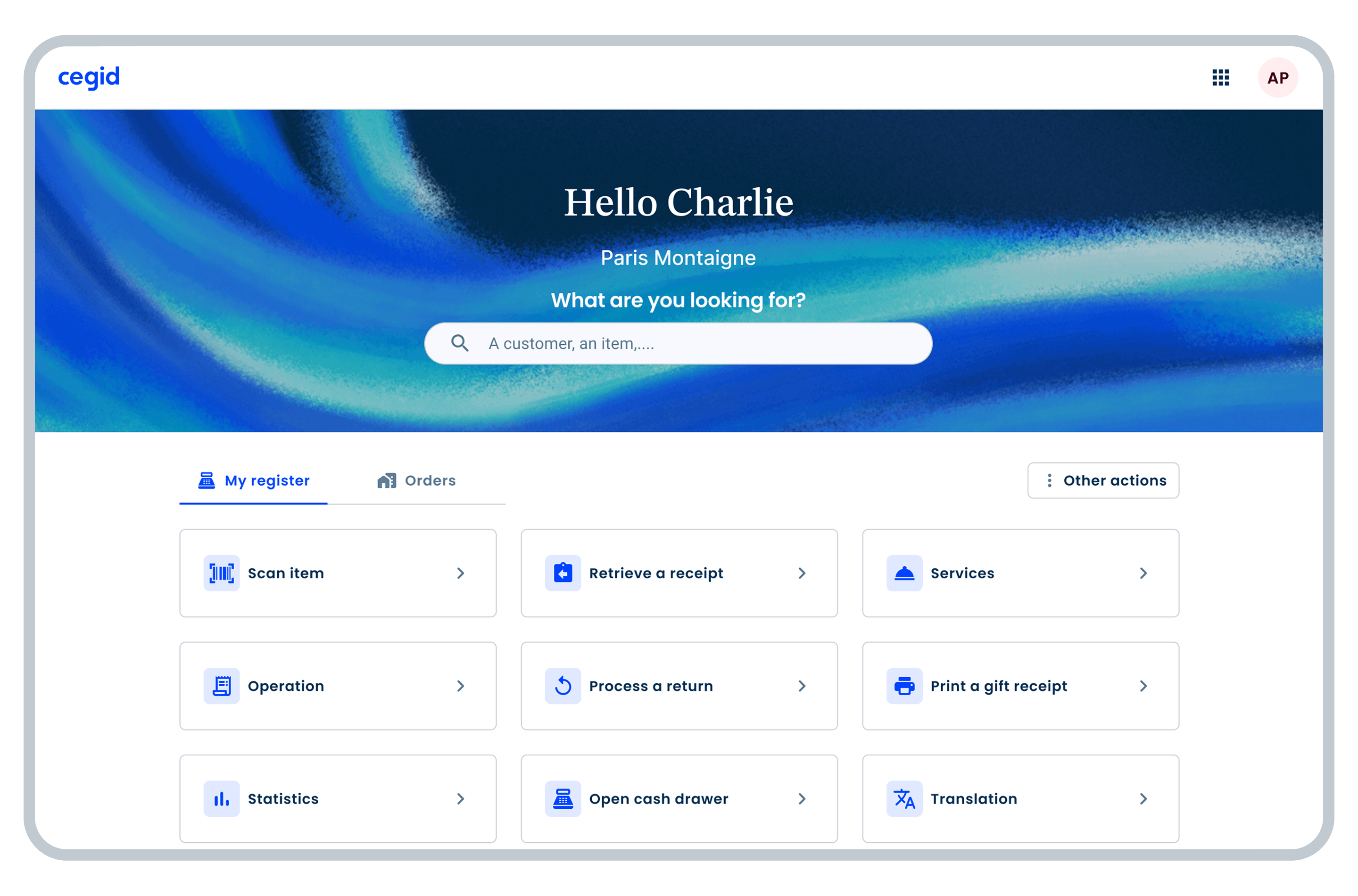
Cegid Retail
A unified sales platform dedicated to retail activities, for an exceptional shopping experience – maximum agility, anywhere in the world.
- Easily manage your omnichannel sales
- Maximize your stock availability
- Manage all your retail activities
- Secure & international SaaS solution

Cegid Retail Store Excellence
A powerful task management platform for all your retail teams.
- Stores will never miss a task again
- Clear and targeted operational comms
- Visual Merchandising Excellence
- Checks and audits you can count on
Our recommended articles

Best POS solution for a UK fashion brand: how to choose by network size
A UK fashion brand with five stores and one with fifty are not choosing the same kind of POS. The right answer depends on stock complexity, channels and growth plans…
Article 21 October 2026 15 min

Peak Season 2026: Why Your Store Systems Are Costing You Sales
Peak season reveals what's broken. Fix your store systems before the rush hits.
Article 20 October 2026 4 min
Which Omnichannel POS Solution Suits a European Network of 300 Stores?
Managing 300 stores spread across several European countries is a fundamentally different challenge from running a national network. At this scale, the choice of an omnichannel POS solution hinges on…
Article 19 October 2026 7 min