
Retail
Application Fragmentation: The Hidden Cost for Retailers

Published on 6 August 2026
Modified on 17 September 2026
7 min

A sales associate opens one app, then another, then another again. Over a single day, they switch interfaces dozens of times. Each time, they log back in, get their bearings, and lose track of what they were doing.
This isn't an isolated case: it's the daily reality for millions of store associates.
For years, retailers have piled up digital tools for their frontline store teams—sales, clienteling, inventory management, operational tasks, internal communication, performance tracking. Each one answers a specific need. But put end to end, they create a problem far deeper than a simple software line item: application fragmentation whose real cost far exceeds the price of the licences, and whose actual adoption by frontline teams often falls well short of initial expectations.
This phenomenon is often treated as a technical irritant, managed behind the scenes by IT teams. In reality, it's a boardroom issue: it weighs on sales performance, service quality, talent retention and the ability to transform. This article lays out these hidden costs, backed by figures, and how retail leaders can regain control.
A Quantified Reality
The figures set the scene. According to the Connected Shoppers Report (6th edition, 2025, Salesforce), new store associates must master an average of 16 different systems in their day-to-day work, up from 12 in 2023—a 33% rise in two years. These tools require 26 hours of training in the very first month, purely to learn how to navigate between applications, before even serving a customer.
That figure deserves a pause. 26 hours is more than three working days devoted solely to getting to grips with the tools. Not product knowledge. Not customer relationships. Not business processes. The tools.
At the same time, according to Business Wire (2024), nearly 90% of sales associates believe they could deliver a better customer experience if they had mobile technology tools to simplify real-time communication, prioritise their tasks and quickly check prices and stock. The conclusion is clear: teams don’t lack motivation—they lack an application environment that matches it.
And the trajectory won’t reverse on its own. The cause of this build-up is structural:
- The digital acceleration of retail. Omnichannel, real-time customer expectations, new channels: every shift has brought its own tools. Rather than consolidate, retailers have kept adding.
- Acquisitions and partnerships. Every solution added answers a genuine need, but it’s rarely designed to integrate with the others. The application architecture then inherits successive layers that don’t talk to each other.
- The historic absence of a unified vision. Environments were built like stacked bricks, not as a coherent system. Technical debt piles up quietly.
The result: it isn’t the tools that are missing, but their coherence.
Cegid was recently named a Leader in the IDC Marketscape
Dowload the reportA Strategic Issue, Not Just a Technical One
Fragmentation isn’t just an operational irritant. It touches three deep levers of competitiveness.
The Employee Experience and Retention
The new generations of associates—Gen Z and millennials—make up the majority of store teams. They arrive with high expectations of digital tools, shaped by their personal habits. A complex, unintuitive application environment that demands hours of training before it’s usable sends a clear signal about how the retailer views its frontline teams. It’s a genuine driver of attrition, often underestimated in turnover analyses.
The Ability to Transform, for Retail Leaders
Retail leaders have ambitious transformation agendas: rolling out AI in stores, personalising the customer experience, unifying omnichannel data. These projects consistently run into application fragmentation: every new initiative has to work around a heterogeneous existing base, which stretches timelines, inflates costs and complicates governance. A unified architecture, by contrast, becomes an accelerator: new capabilities are added without rebuilding what’s already there.
Competitiveness
According to a Bain & Company study of 66 executives from the world’s top 250 retailers (June 2025), 86% of previous store transformations failed to fully meet their objectives. Yet the drive toward new technology investment isn’t slowing. This figure isn’t an argument for standing still: it underlines that how you transform matters as much as the decision to do so. Retailers that rationalise their application environment before adding new layers—particularly in fashion, luxury and beauty—gain in operational efficiency, service quality and the ability to see their projects through.
The approach taken by the most advanced retailers follows a four-step logic: audit the existing landscape and its real cost, rationalise applications by identifying those that can be merged or removed, unify access into a coherent experience for the associate, and open up the architecture to integrate essential third-party solutions without recreating silos.
What Analysts Say: Toward a Store Operating System
This shift is well documented by the major analyst and consulting firms.
Forrester now describes store tools as “systems of engagement for store associates”—stressing that value no longer lies in the isolated functional richness of each application, but in the ability to give the associate a coherent, simple and continuous experience. Application fragmentation is precisely what destroys that continuity.
Gartner, in its Retail Technology Trends and Hype Cycle for Retail Technologies publications, identifies “Store Associate Superapps” as an emerging trend directly tied to the growing complexity of store work. These super-apps are designed to unify the tools used by frontline teams, improve operational execution and strengthen the employee experience. Gartner positions them not as one more technology gadget, but as a structural response to a problem the market can no longer ignore.
Both analysts note that the current scope of these solutions is mostly “workforce-first”: task management, internal communication, training, onboarding, engagement and team performance tracking. But they point to a clear, converging evolution: these super-apps are set to become a genuine store operating system—moving beyond HR topics alone to progressively orchestrate operations, data access and contextual business intelligence.
This shift is consistent with what Deloitte and McKinsey observe: the most advanced retailers are moving toward platforms capable of becoming an “operating system for frontline teams”, with strong expectations around AI and business contextualisation. The goal is no longer to multiply available features, but to make them accessible at the right moment, in the right context, without friction.
Cegid Retail One: Unifying Tools for Retailers
This is precisely the approach behind Cegid Retail One. It isn’t one more application, but a unification layer that brings together your apps—both Cegid’s and third-party solutions—into a single, coherent experience for frontline teams.
In practice:
- One single login. A single set of credentials gives access to all the tools, without juggling multiple logins.
- One single interface. Sales, stock, operations and performance are all accessible from the same environment, which limits context-switching and reduces handling time.
- Integrated modules. Cegid Retail One brings the Cegid Retail modules together into a unified experience and, through connectors, lets you integrate the third-party applications in your ecosystem.
- An AI assistant. Built into the interface, it gives real-time access to business data—product availability, a customer’s purchase history, a department’s performance—without leaving the application.
- Role-based configuration. Access and views adapt to the profiles and processes of each retailer, so every team member has exactly what they need, no more and no less.
One important point: this isn’t a replacement. Your Cegid Retail applications and your third-party solutions keep working. Cegid Retail One orchestrates them within a single store experience, with no migration and no disruption.
Discover Cegid Retail One
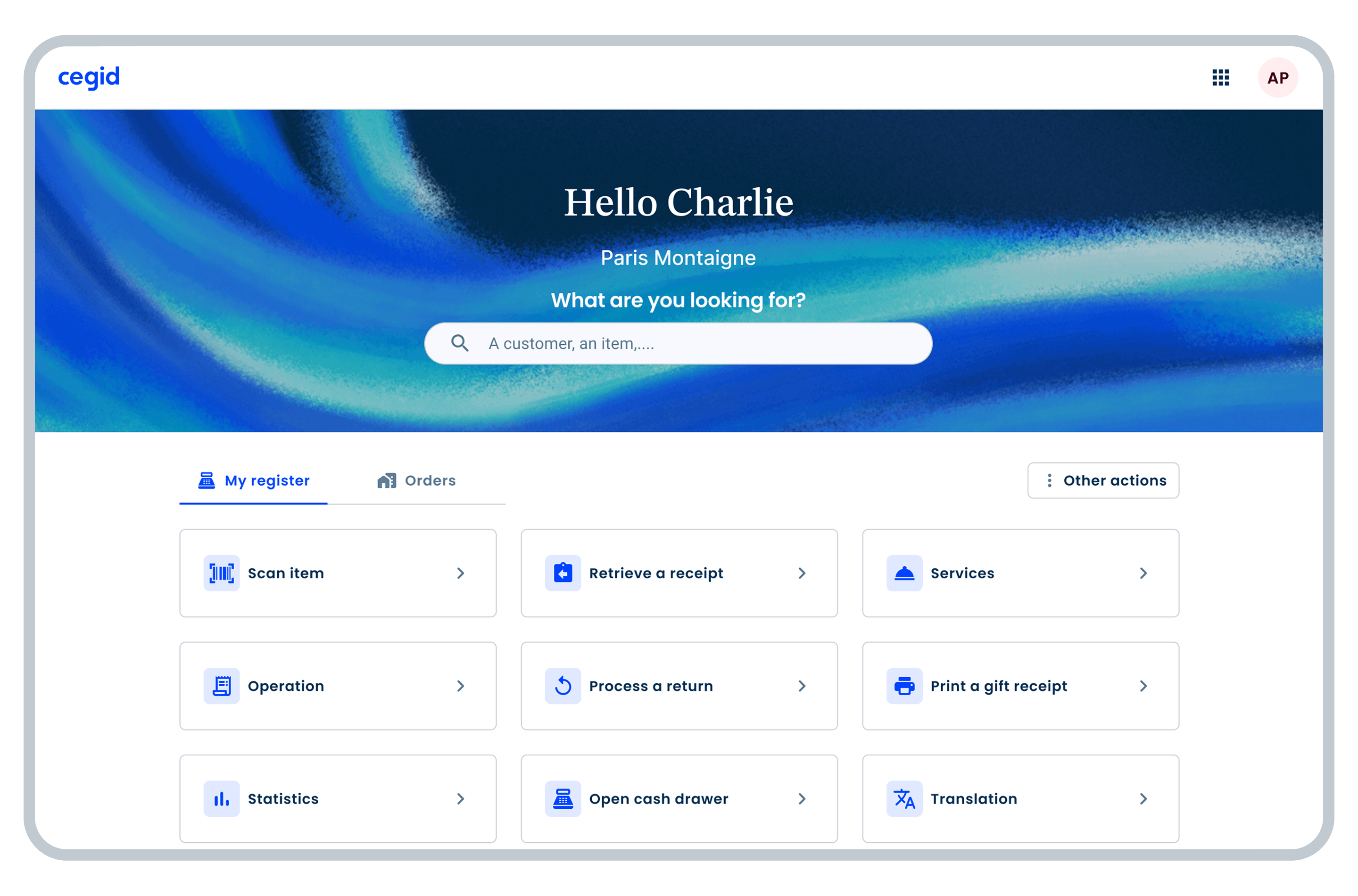
Cegid Retail
A unified sales platform dedicated to retail activities, for an exceptional shopping experience – maximum agility, anywhere in the world.
- Easily manage your omnichannel sales
- Maximize your stock availability
- Manage all your retail activities
- Secure & international SaaS solution
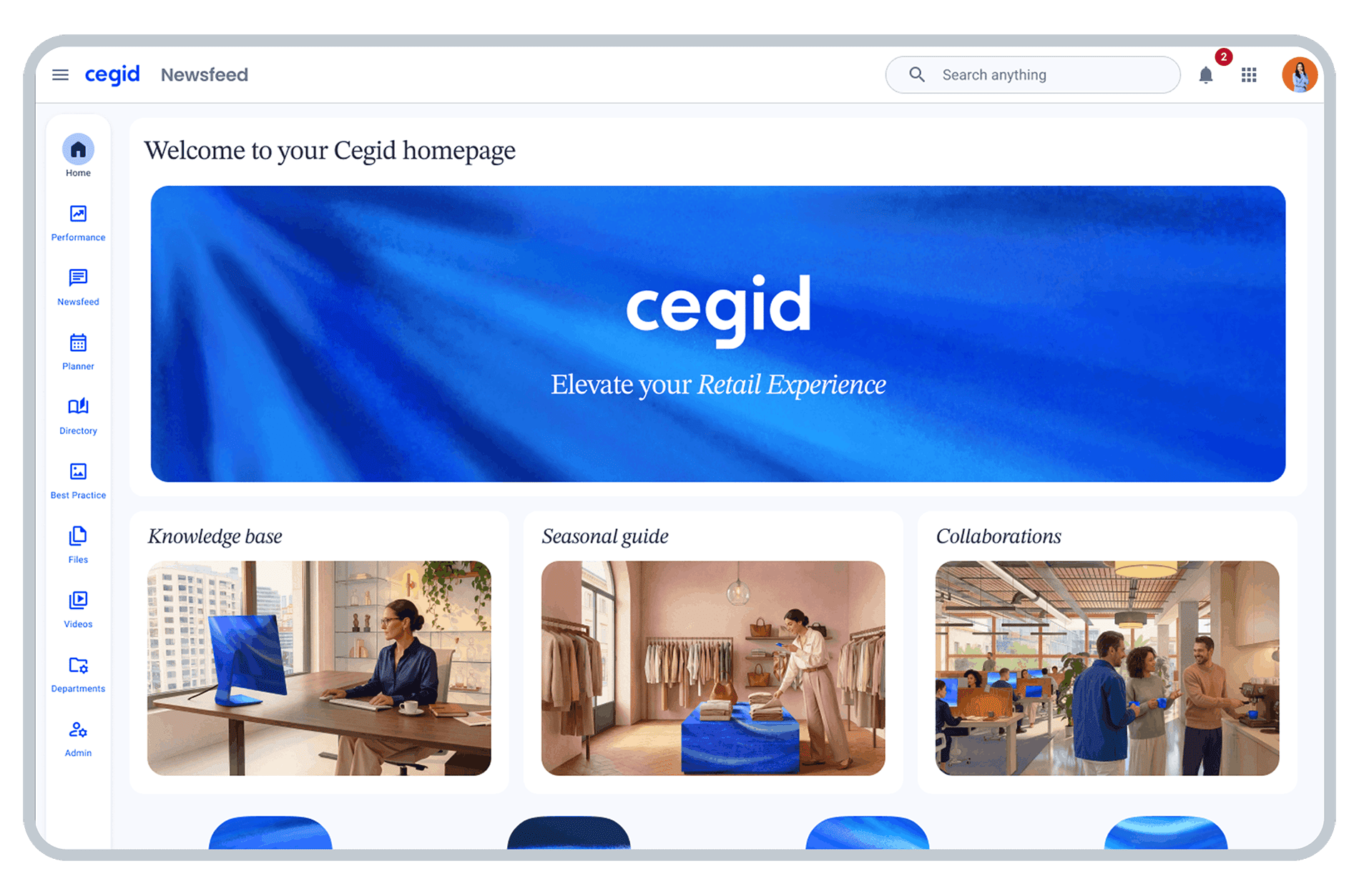
Cegid Retail Store Excellence
A powerful task management platform for all your retail teams.
- Stores will never miss a task again
- Clear and targeted operational comms
- Visual Merchandising Excellence
- Checks and audits you can count on
Our recommended articles

Peak Season 2026: Why Your Store Systems Are Costing You Sales
Peak season reveals what's broken. Fix your store systems before the rush hits.
Article 21 October 2026 4 min

Best POS solution for a UK fashion brand: how to choose by network size
A UK fashion brand with five stores and one with fifty are not choosing the same kind of POS. The right answer depends on stock complexity, channels and growth plans…
Article 21 October 2026 15 min

Which Omnichannel POS Solution Suits a European Network of 300 Stores?
Managing 300 stores spread across several European countries is a fundamentally different challenge from running a national network. At this scale, the choice of an omnichannel POS solution hinges on…
Article 19 October 2026 7 min