
Human Resources
Skills Mapping: The Complete Guide to Agile HR Management
12 June 2026
9 minutes

Unlock Hidden Talent. Address Skills Gaps. Strengthen Organisational Performance.
Job titles and credentials no longer suffice for effective workforce management, especially when 1 in 10 jobs could disappear by 2030. To manage your talent strategically, skills mapping is essential: a capability-focused approach that transforms traditional HR practice.
What if your talent management platform gave you precise visibility into current workforce capabilities and identified skills gaps before they become critical? Skills mapping, central to skills management methodology, visualises and actively manages your team’s technical skills and interpersonal capabilities. This comprehensive guide walks you through integrating skills mapping into your HR strategy, enabling internal mobility, and optimising team performance.
5 Key Metrics: Why Skills Management Matters
49% of Canadian Adults Participated in Training in 2022
This level exceeds the North American average, yet remains below the target of 65% by 2030. What is the participation rate within your organisation?
6 in 10 Canadian Adults Possess Basic Digital Skills
A solid foundation, but falling short of the global target of 80% by 2030. Can you quantify this capability gap precisely within your company?
19% of Workers Are Overqualified for Their Roles
These employees possess qualifications above what their position typically requires. Strategic internal mobility can unlock this hidden potential and accelerate advancement.
Conversely, 12% of Workers Are Underqualified
Their qualifications fall below role requirements, creating capability gaps that limit agility and performance. Targeted skills development bridges this gap.
Key Takeaways
- Continuous learning is essential to maintain workforce competitiveness and meet 2030 targets
- Most adults possess foundational digital skills, yet capability gaps persist across your organisation
- Worker overqualification and underqualification reveal urgent needs for internal mobility and strategic talent development
What is Skills Management (and Why Competency Mapping is Essential)
In 2003, IBM’s HR team faced a challenge: managing rapid workforce expansion across global operations. Anticipating the power of data analytics, IBM invested in systems to track and deliver comprehensive intelligence on its most valuable asset: talent. Skills-based management was born.
Defining Skills Management
Emerging in the early 2000s, skills management is an approach to workforce decision-making and talent administration grounded in capability assessment rather than job titles.
Skills management fundamentally differs from traditional HR models where people decisions rely primarily on job descriptions and organisational hierarchy.
Skills Management vs. Traditional HR: 5 Critical Differences
What separates capability-driven management from conventional HR? Discover the five core distinctions that reshape how you lead talent:
| Differences | Traditional HR Approach | Skills-based / Skills Management Approach |
|---|---|---|
#01 Starting Point | Job titles | Demonstrated capabilities and competencies |
#02 HR Decision Basis | Role classification, credentials, tenure | Verified skills and performance |
#03 Internal Mobility | Vertical advancement aligned to career plans | Cross-functional movement based on capability gaps and project needs |
#04 Development Strategy | Standardised programmes by function | Individualised pathways aligned to skill gaps |
#05 Organisational Structure | Hierarchical, siloed functions | Agile, project-centric, capability-driven |
Skills Management: 3 Core Principles
- Skills management places demonstrated capability at the centre of HR decisions, beyond job titles and traditional profiles
- It challenges conventional HR by prioritising verified skills over hierarchical position
- This approach unlocks internal mobility and enables personalised career development
Skills Mapping: Definition
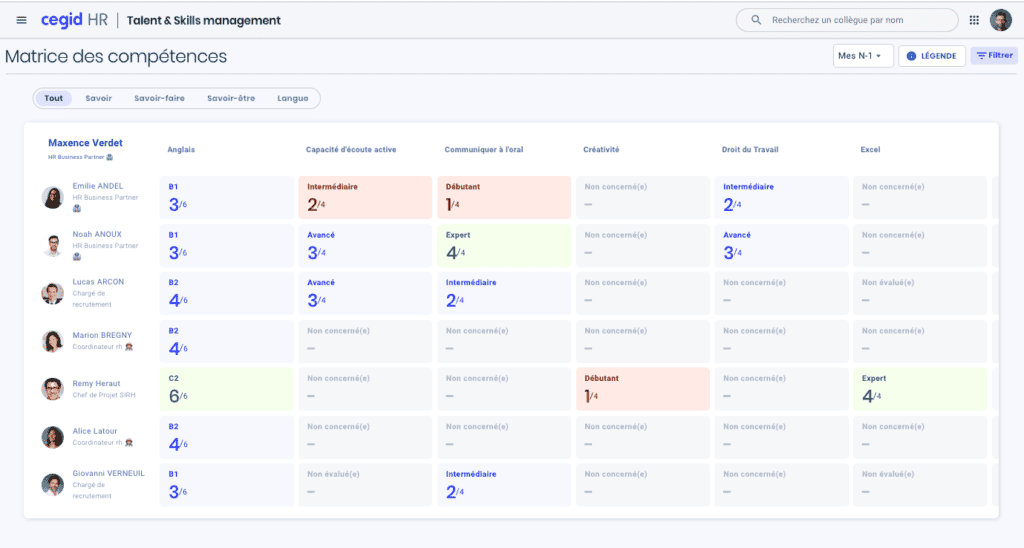
Skills mapping is the foundation of skills management. This process enables HR to visualise all capabilities within your workforce and their distribution across the organisation. It provides structured, complete visibility into your company’s current capability landscape.
Already familiar with the basics? Jump to the key implementation steps.Its effectiveness depends on data collection: there is no skills mapping without a robust HRIS. The mapping process relies on two key elements:
- The Skills Matrix: A structured table that aligns all capabilities present in your organisation (or required for growth) against individual employee proficiency levels.
- The Skills Framework: A comprehensive inventory of all capabilities essential to your business operations. Leading talent management platforms integrate dynamic skills frameworks – adaptable competency libraries you customise to your industry and strategic priorities.
Why Skills Mapping Matters
Skills mapping enables you to:
- Identify capability strengths and gaps across your organisation
- Build personalised development plans and career pathways
- Enable internal mobility, strengthen talent management, and guide strategic planning
The strategic value of skills management, particularly skills mapping, operates at every organisational level:
| From the Perspective of: | How Skills Mapping Works |
|---|---|
For HR | Access real-time visibility into capability distribution to inform talent decisions and identify strategic high-value contributors. |
For the Organisation | Analyse gaps between current and required capabilities to prioritise training investments and close performance gaps. |
For Employees | Understand which skills matter for advancement and unlock internal mobility opportunities aligned to your career ambitions. |
Skills Mapping: The Essentials
- Skills mapping is a structured view of capabilities your employees currently hold and those your organisation requires
- It combines technical and interpersonal skills to deliver a complete snapshot of your human capital at a specific point in time
- Core tools: the skills matrix and the skills framework
Core Competencies: Classification and Identification
Before effectively visualising and managing capabilities across your organisation, you must understand and classify the different competency types that constitute your human capital. Technical skills, interpersonal skills, core competencies (cross-functional capabilities): by aligning these categories coherently, HR can better anticipate future needs and design career pathways that truly resonate with employees.
The HR Skill Mix Required for Effective Skills Mapping
What capabilities must HR develop to transition from traditional management to skills-based organisation? To engage all stakeholders in this transformation, the critical competency to build is leadership, which HR exercises across the entire organisation.
Seventy years ago, Robert Katz theorised the competencies of effective leaders in the Harvard Business Review. He identified three distinct capabilities every leader should develop, and which your HR function can cultivate to drive digital transformation:
- Technical competencies (hard skills)
- Human competencies (soft skills)
- Conceptual competencies (creative thinking)
How does your HR function master the skills required for digital transformation? By selecting a technology partner committed to supporting you and building capability at every stage, particularly when implementing skills mapping.
Soft skills
Often called interpersonal or people skills, soft skills reflect how you show up in the workplace: communication, interpersonal and intrapersonal skills, leadership and learning. For example, here are the 12 soft skills employers were looking for most in 2025:
- Active listening
- Verbal communication
- RespectOpenness to feedback
- Accountability
- Professionalism
- Organizational skills
- Autonomy
- Positive attitude
- Trust in others
- Problem solving
- Openness to new ideas
Hard skills
Long at the centre of traditional HR practices, hard skills are technical skills. The three areas employers valued most in 2025 say a lot about how work is changing:
- AI and big data
- Networks and cybersecurity
- Technological literacy
These hard skills are becoming obsolete faster than ever, but a third category can offset that: core skills, also known as transferable skills.
Core skills, or transferable skills
39% of today’s skills will be outdated by 203010. In this context, organizations have every reason to identify and map core skills, the key transferable skills that shape the right mindset. So which soft skills count as core skills?11
- Analytical thinking: analyzing data and solving complex problems.
- Resilience, flexibility and agility: adapting to navigate uncertainty and rapid change.
- Leadership and social influence: motivating and guiding others toward goals and bringing teams together.
- Creative thinking: generating new ideas to meet a wide range of challenges.
- Motivation and self-awareness: pursuing self-development and understanding your strengths.
- Empathy and active listening: understanding others and listening well to give constructive feedback and build a climate of trust.
- Curiosity and lifelong learning: continually wanting to learn new skills.
And then there is talent management: the ability to identify and develop each person’s skills, a responsibility that rests with Human Resources. If transferable skills are the key to future competitiveness, HR is the one holding the keys!
Key takeaways: The 3 types of skills in skills management
- Classifying skills as soft skills, hard skills and core skills (transferable skills) helps organizations anticipate future needs.
- This framework enables HR to drive both individual and team development.
- The real challenge is finding the right mix of all 3 skill types.
Technology tools that power skills management
To map skills across an organization at scale, an HR suite is essential. Here is how a skills management solution works:
- It gives you a customizable skills framework to take inventory of key skills.
- It collects data from all your HR apps, modules and tools to give you a complete view of the skills across your organization.
“Because skills have become fundamental in a rapidly changing world, we chose to focus our efforts on developing intelligent skills management solutions that help organizations catalogue, categorize and identify the skills they have and the skills they will need, so they can find, develop and grow their talent as nimbly as possible.” Cegid
Strategic workforce planning: 8 features to look for when assessing employee skills
Assessment tools
- Create assessment forms from customizable templates
- Manage multiple recruitment campaigns at the same time
- Assess key skills based on the job description
Performance reviews and 360-degree feedback
- Carry over objectives and all active OKRs from one review to the next
- Assess collaboratively with 360-degree forms that can be viewed during the review
- Track objectives in coaching mode for personalized support
Metrics and progress tracking
- Quantify progress with the right KPIs and visualize it with the right dashboards
- Offer a broad catalogue of blended and microlearning courses, with certification modules to track learner progress
Key takeaways: HR tools for skills mapping
- Modern HR solutions offer assessment and inventory features that make skills mapping easier.
- They help identify skills gaps and plan targeted development initiatives.
- When they are collaborative, these tools strengthen employee engagement and optimize overall performance.
Key steps in a skills mapping process
In practice, what are the 5 steps to map skills effectively?
1. Objectives and skills needs
Before taking any action, clarify what the skills map needs to achieve. Should it help you anticipate future needs or encourage internal mobility? Build your training plan or identify key talent? This step aligns the process within your HR strategy with business priorities. It also defines the scope and criteria to use throughout the rest of the process.
2. Skills inventory and classification
This step involves gathering the existing and required skills across the organization through interviews, self-assessments and manager assessments, and cross-referencing other data sources, such as resume parsing. At this stage, a tool with a built-in skills library is useful for building a complete inventory of technical skills, soft skills and transferable skills. Make sure the tool you choose offers customization options so you can add skills specific to your organization.
3. Proficiency level assessment
Once listed, skills must be assessed using a proficiency scale (for example: beginner, intermediate, expert) based on objective criteria. This assessment can be completed by employees or their managers, using rating grids or interviews. It highlights employees’ strengths and gaps relative to the organization’s needs.
4. Building the skills framework
The skills framework is the foundation that links each job or function to its associated skills and required proficiency levels. It serves as the basis for all future uses (training, recruitment, internal mobility). A standardized framework ensures that everyone involved in HR makes the right decisions.
5. Skills gap analysis and development plan
The first 4 steps should help you identify the gaps between the skills your organization has and the skills it needs. Based on this, you can build a tailored development plan to close those gaps, strengthen employability and support strategic objectives. This step leads to concrete, measurable decisions.
Key takeaways: 5 steps to map skills in your organization
- Define your objectives and skills needs, aligned with your business strategy.
- Inventory and classify skills by gathering input from employees (interviews, self-assessments, manager assessments).
- Assess the proficiency level (beginner, intermediate, expert) for each skill.
- Build a skills framework for each function or job family.
- Analyze skills gaps and create a tailored development plan (training, recruitment, internal career growth).
FAQ: Everything you need to know about skills mapping
How do you create a skills map?
Skills mapping follows a structured approach. It starts with defining your objectives: anticipating future needs, supporting internal mobility or building a training plan.
Skills are then inventoried from various sources (HR interviews, self-assessments, manager assessments, job descriptions, HRIS data) and classified as hard skills, soft skills and transferable skills.
Each skill is assessed by proficiency level (beginner, intermediate, expert). This information is used to build a skills framework that links jobs to the skills they require.
Finally, analyzing the gaps between current and required skills makes it possible to define concrete actions: training, internal mobility or targeted recruitment.
Why is skills mapping important?
Skills mapping gives you a clear, shared view of your organization’s human capital. It helps identify strengths, gaps and the skills that are critical to your medium- and long-term strategy.
For HR, it supports objective decisions about training, career management and internal mobility. It helps align skills with business priorities and strengthens organizational agility.
For employees, it provides visibility into the skills they need to develop and the growth opportunities available to them, fostering engagement, employability and talent retention.
Conclusion
1 in 10 jobs could disappear by 2030. With the job market changing this quickly, skills mapping is a process that helps you anticipate needs and manage your talent effectively.
- Skills mapping helps you identify your employees’ strengths and gaps so you can adapt your development plans and career paths.
- It supports internal mobility and aligns skills with your organization’s strategic priorities.
- By structuring hard skills, soft skills and core skills, HR can build a more agile organization that is better prepared for market shifts.
Want to learn more about Cegid HR?
Fill out the form and we’ll get back to you!
Let's goOur recommended articles

You’re not losing talent. You’re failing to onboard them.
Successful Employee Onboarding: Beyond Day One. Why Onboarding Drives Engagement and Talent Retention
Article 30 August 2026 4 minutes

Transforming Skills Management: From Theory to Strategic Execution
Transform Skills Management Into Your Strategic Advantage: Dynamic Framework, AI, HR Leadership, and Talent Development at the Core of Performance
Article 7 July 2026 4 minutes